Loft conversion costs in London, 2026
Dormer, mansard, hip-to-gable, Velux — what each type of London loft conversion actually costs in 2026, plus the hidden costs and planning traps.
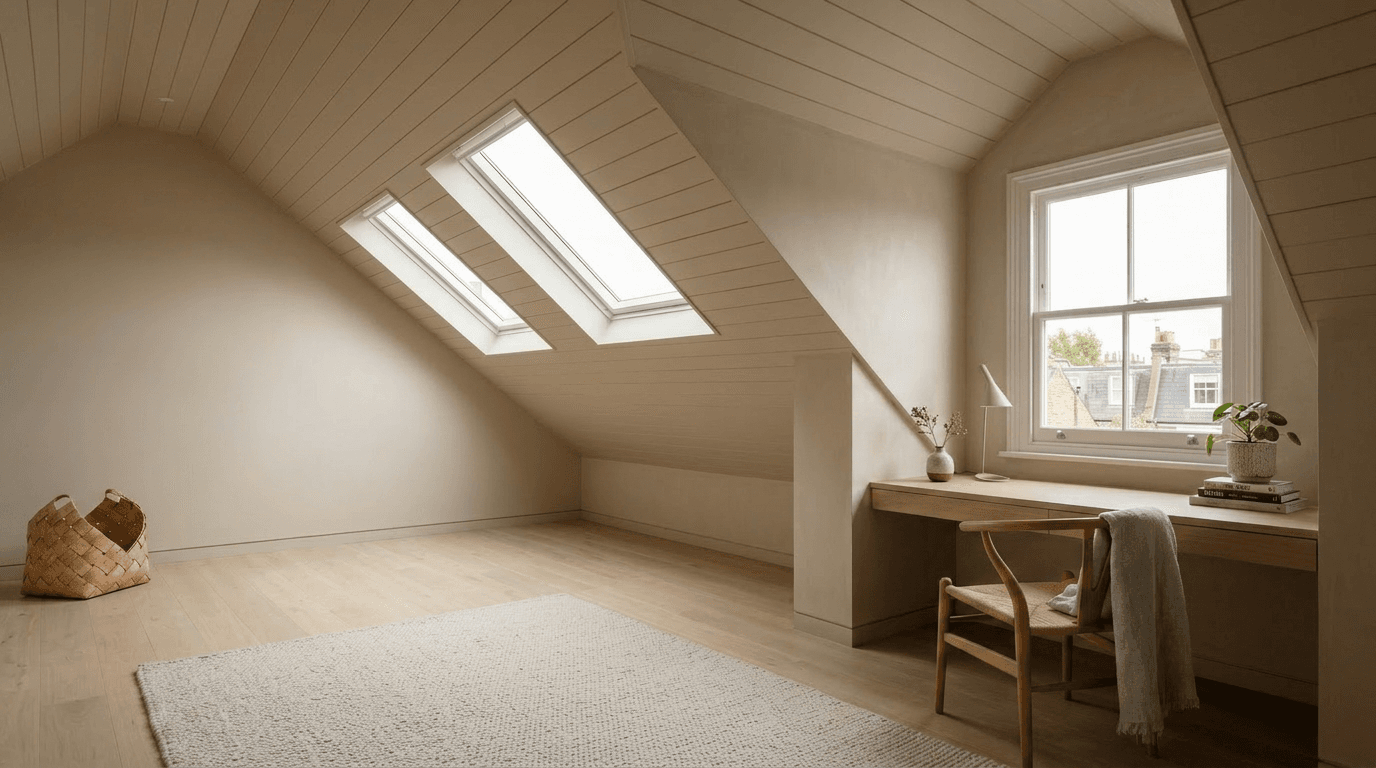
A loft conversion is usually the single best pound-for-pound investment you can make in a London house. Adds a bedroom, often an en-suite, and somewhere between 15% and 25% to the property's value. Here's what it actually costs in 2026.
The four types — and their London prices
Velux / rooflight conversion — £40,000–£60,000. No change to roof shape, just skylights inserted, floor strengthened, staircase added, insulation, electrics, plaster. Only works if you already have enough head height (2.3m+ at the ridge). Rare in London terraces without raising the ridge.
Dormer conversion — £65,000–£95,000. The most common London conversion. A box-shaped extension pushed out from the rear roof slope. Adds usable standing room. Permitted development in most boroughs (check Article 4). Adds a full bedroom + en-suite in most Victorian/Edwardian terraces.
Hip-to-gable — £75,000–£110,000. For semis and end-of-terrace houses where the side roof slopes down (the "hip"). You extend the gable wall up to square off the roof, then typically add a rear dormer. Much more space than a plain dormer. Often needs planning.
Mansard conversion — £100,000–£160,000+. The top tier. The entire rear of the roof is replaced with near-vertical walls, creating a near-full-height additional floor. Massive space gain — often 2 bedrooms + bathroom. Always needs full planning, often requires party wall agreements. Common and often encouraged in central London conservation areas because it hides behind the parapet.
Cost per square metre
Roughly £1,800–£2,500/m² for a standard dormer, £2,500–£3,500/m² for a mansard, higher for listed buildings or particularly fiddly rooflines.
What drives the price up or down
Up:
- Conservation area or Article 4 removal of permitted development rights
- Listed buildings (always)
- Steel beams needed across the original ceiling joists
- Relocating cold water tanks, soil stacks, or SVP
- En-suite required (adds £8,000–£14,000)
- Bespoke Juliet balconies, full-height glazing, or oak-framed dormers
- Scaffolding on complicated rooflines or with difficult access
- Party wall surveyor fees (often £800–£2,000 per neighbour)
Down:
- Simple Velux-only with existing head height
- No bathroom in the new room
- Stock staircase instead of bespoke
- Terraced house with easy scaffolding access
- Existing structure that can take the load without heavy steels
Hidden costs nobody quotes for
- Fire safety. Any new habitable room on a new floor triggers fire regs. Mains-wired interlinked smoke alarms throughout the house, fire doors on all habitable rooms opening onto the escape route, 30-min fire-rated ceilings on the floors below. £3,000–£6,000 just for compliance retrofit.
- Extending the heating system. Boiler may need upsizing. New radiators on the loft level. £1,500–£3,500.
- Water pressure. If you've got a gravity-fed system and a cold water tank in the loft, that tank has to go — which means relocating or switching to unvented mains. £2,500–£5,000.
- Party wall. If you're on a terrace or semi, the Party Wall Act applies. Budget £800–£2,500 per neighbour for their surveyor's fees.
- Carpet, fitted wardrobes, furniture. Often £3,000–£8,000 more after the "build" is finished.
Planning
Most London loft conversions fall under Permitted Development (PD), but with strict limits:
- Terrace: max 40m³ additional volume
- Semi/detached: max 50m³
- No extension beyond the original roof plane on the front elevation
- Side-facing windows must be obscure-glazed and non-opening (below 1.7m)
- Roof materials must match the existing
- No raising the ridge height
- PD removed in many conservation areas — check your borough
If PD doesn't apply, you're looking at full planning (8+ weeks). Listed buildings always need Listed Building Consent.
Timeline
Dormer: 10–14 weeks on site, plus 4–8 weeks for design and consents. Mansard: 16–22 weeks on site.
Worth doing?
In most of zones 1–4 London, yes. A £75,000 dormer typically adds £120,000–£200,000 to a 3-bed Victorian terrace's value. That's the strongest ROI of any renovation outside of an extension.
Thinking about a loft conversion? Book a consultation — we'll survey your roof, check planning, and send a fixed quote before you commit.