Wet room vs walk-in shower — which is right for your London bathroom?
Cost, practicality, resale, and the plumbing realities. When a wet room is the right call in a London home, and when a walk-in shower beats it.
Both look great in a brochure. On site, they're very different projects with very different price tags and very different risks. Here's how to pick.
The difference
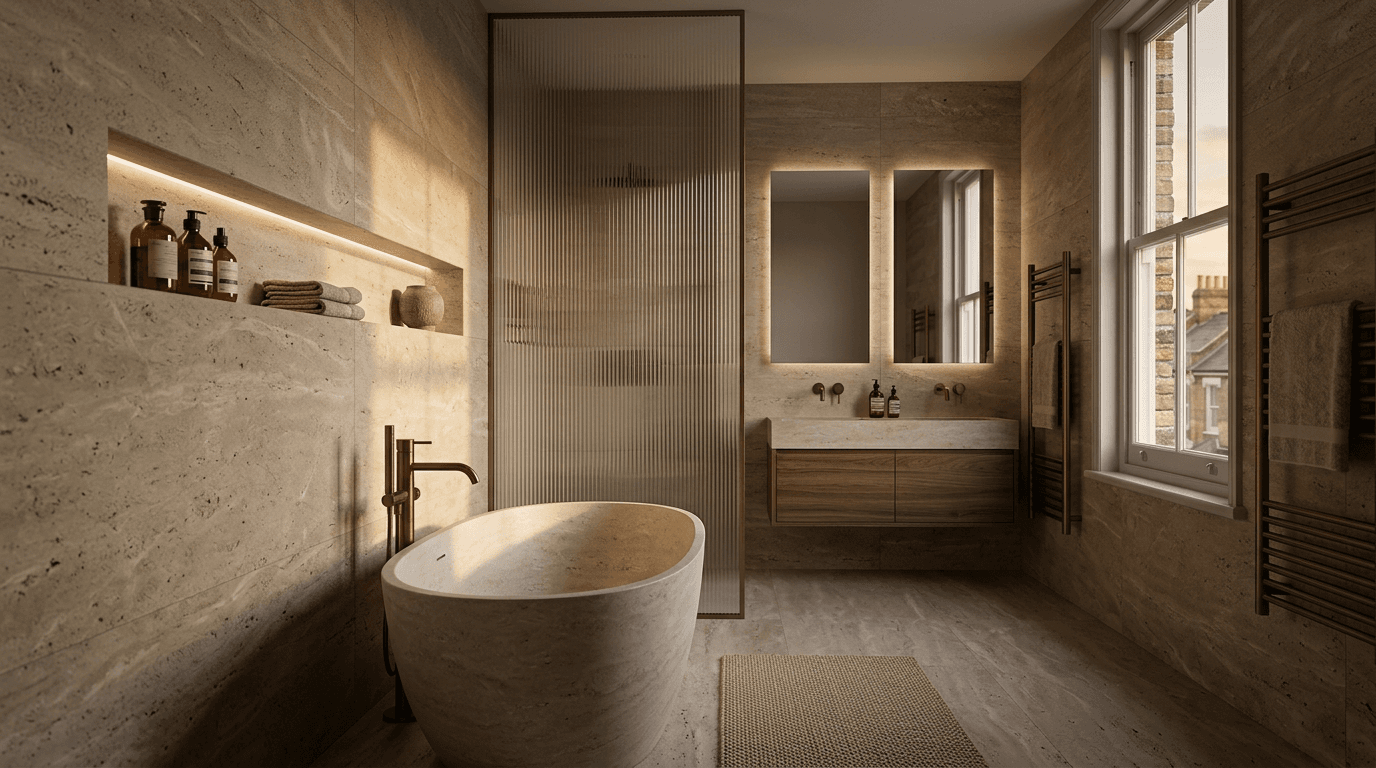
- Walk-in shower: a large open-fronted shower enclosure with a low-profile tray (or tiled floor inside a raised kerb) and a glass panel. The rest of the bathroom floor is separate.
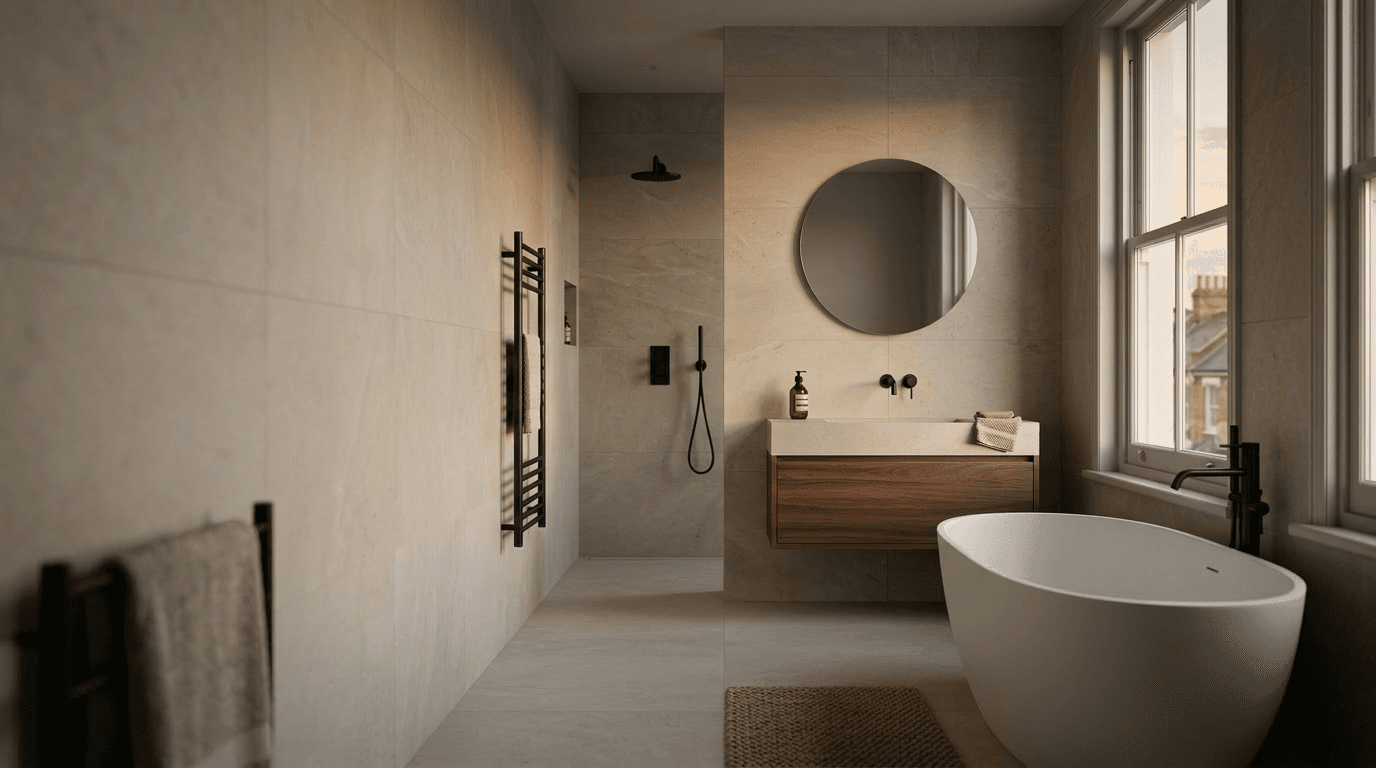
- Wet room: the entire bathroom floor is tanked, graded to a drain, and tiled. There's no kerb, no tray, no physical separation between shower and room. Water goes everywhere, and that's fine — because everything is waterproof.
What each costs
Walk-in shower (London, 2026): £3,500–£7,500 as part of a new bathroom, depending on tray type, glass spec, tile choice and mixer hardware.
Wet room (London, 2026): £6,500–£14,000 as part of a new bathroom, driven mostly by tanking, linear drain, underfloor heating, and the extra tiling labour.
When a wet room is the right call
- Small bathrooms (under ~3.5m²). Removing the tray / separate shower cubicle physically saves space. A wet room feels a full size larger than a traditional layout.
- Main bathroom you want to futureproof. Wet rooms are level-access by design — matters for ageing in place or accessibility.
- Modern, minimal design brief. A seamless stone-tiled floor is a serious upgrade to the finish.
- You have a solid subfloor (concrete or properly reinforced joists). Wet rooms need a completely level, rigid base.
- You accept the upkeep. Grout lines take more cleaning than a glass shower enclosure. A squeegee becomes a daily thing.
When a walk-in shower is the better call
- Only bathroom in the home and it's used by multiple people. Wet rooms and kids taking baths don't mix well — and without a raised tray, water migration gets inconvenient.
- You're in a flat above others. Wet rooms done well are fully watertight. But if they're done badly, the consequences are catastrophic for the flat below. Walk-ins with a low tray + glass panel are lower risk.
- Resale in a mainstream London market. Mid-market London buyers often prefer a bathtub somewhere in the property. A walk-in shower leaves space for a separate bath. A wet room often replaces the bath.
- Timber-framed extensions / lofts. Wet rooms need near-rigid subfloors. Most timber lofts flex — even a small deflection breaks the tanking seal. Use a wet room in a loft only if the structural engineer signs off and you use a proper tanking system like Kerdi or Wedi.
The tanking nobody thinks about until it leaks
A real wet room has three waterproof layers under the tiles:
- Tanking membrane (liquid or sheet — Kerdi, BAL WP1, Homelux) across the entire floor and at least 1.8m up every wall the shower touches.
- Waterproof jointing at every corner and pipe penetration.
- Proper grade to the linear drain — typically 1:80 fall minimum, pre-sloped with a manufactured former (Wedi Fundo, Impey AquaDec).
Budget £1,800–£3,500 for tanking alone on a proper wet room, on top of tile cost. Anything significantly cheaper than that is skipping a layer. And a cheap wet room is an expensive wet room — leaks through a ceiling into the flat below cost £15,000–£50,000 to put right, not including the relationship damage with your neighbour.
Drains
- Central square drain: simpler, cheaper, but harder to keep looking clean.
- Linear drain (Geberit, Impey, McAlpine): more expensive, more complex to install (falls from all four sides to a single line), looks much better.
- Wall drain: rare but cleanest aesthetic — water flows to a gap at the base of one wall.
For a premium finish, specify a linear drain with a tileable insert — it disappears into the floor and reads as one continuous tiled plane.
A note on "part wet rooms"
Some of the best London bathrooms we do are "wet zones" — a tanked, drained shower area inside an otherwise traditional bathroom. You get most of the wet-room look in the shower (no tray, no kerb, tiled walls and floor flowing together), but with the rest of the room conventional. Lower risk, lower cost, still gorgeous. Often the right middle ground.
Planning a London bathroom? Get in touch — we'll look at your space, talk you through wet room vs walk-in vs wet zone, and quote properly for whichever suits.